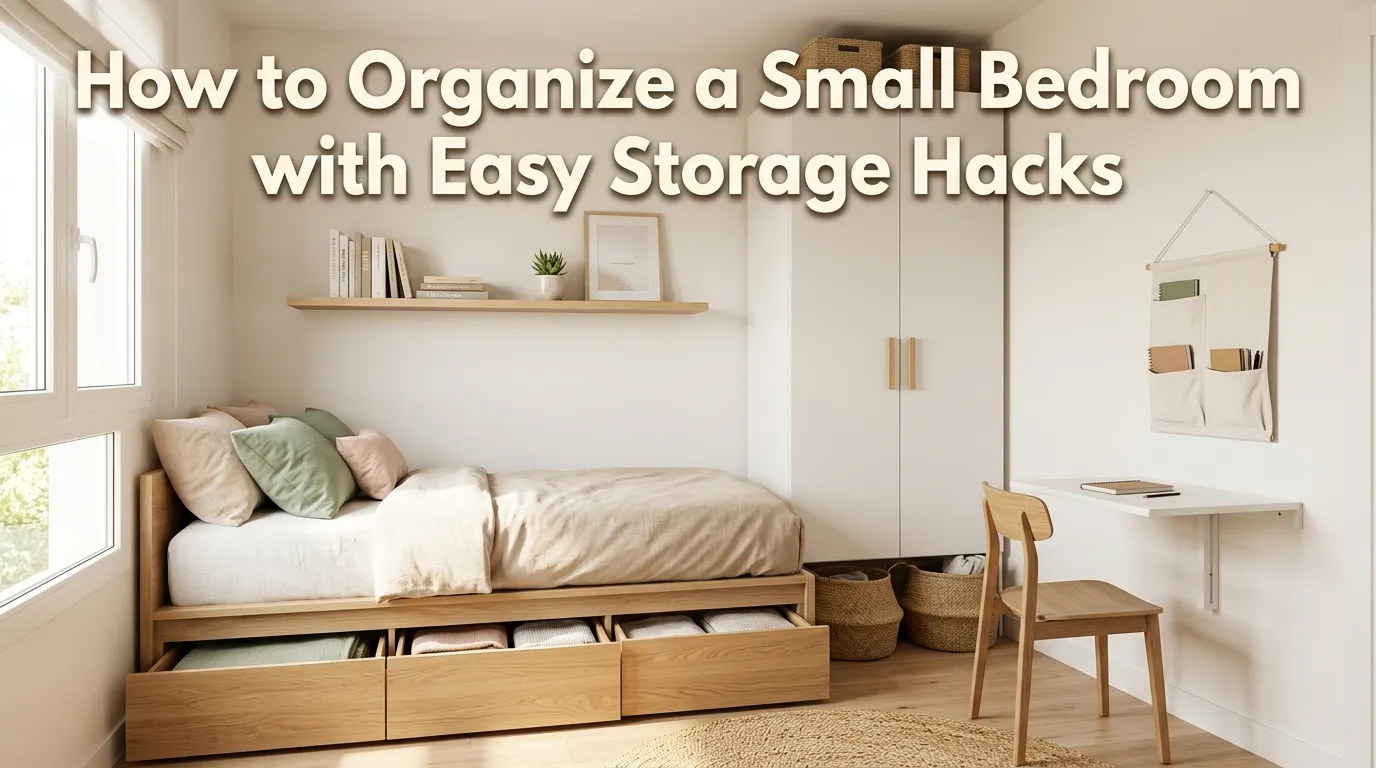
How to Organize a Small Bedroom with Easy Storage Hacks
A small bedroom can feel surprisingly difficult to organize. There may be enough space for your bed and basic furniture, yet somehow clothes, shoes, books, bags, and everyday essentials still seem to end up everywhere.
The problem is often not the amount of storage you have. It’s how efficiently you’re using the space that’s already there.
In a compact bedroom, every wall, corner, drawer, and inch beneath the bed can serve a purpose. The goal isn’t to squeeze more containers into the room. It’s to create storage that makes everyday routines easier while keeping the bedroom comfortable and visually calm.
I’ve noticed that the biggest improvement often comes from giving frequently used items a specific home. When clothes, accessories, and personal belongings have logical storage locations, tidying up takes much less effort.
You also don’t need to buy expensive furniture to make meaningful changes. Simple solutions such as under-bed containers, over-the-door organizers, wall hooks, drawer dividers, and vertical shelving can dramatically improve how a small room functions.
Another important consideration is what you actually use. Storage becomes much easier when you avoid giving valuable space to things you rarely wear or need. Before adding organizers, take a few minutes to remove obvious clutter.
The ideas below focus on practical storage solutions that work particularly well in compact bedrooms. Some are almost free, while others involve small upgrades that can make a noticeable difference.
Whether you’re organizing a tiny apartment bedroom, a guest room, a child’s room, or a small primary bedroom, these ideas can help you create a space that feels more orderly without sacrificing comfort or style.
Table of Contents
1. Under-Bed Storage
Turn unused space beneath the bed into practical hidden storage.
2. Vertical Wall Shelves
Use wall height to store items without taking valuable floor space.
3. Over-Door Organizers
Transform the back of a door into convenient storage.
4. Closet Dividers
Make a small closet easier to navigate and maintain.
5. Drawer Organization
Use simple dividers to prevent small items from becoming cluttered.
6. Wall-Mounted Hooks
Create accessible storage for bags, accessories, and everyday clothing.
7. Multi-Use Furniture
Choose furniture that performs more than one function.
8. Corner Storage
Make awkward corners useful without overcrowding the room.
9. Seasonal Rotation
Free up valuable space by storing less frequently used items elsewhere.
10. Decluttered Surfaces
Keep visible surfaces clear to make the bedroom feel more spacious.
1. Under-Bed Storage
Quick Benefits
- Uses otherwise wasted space
- Keeps belongings hidden
- Works for seasonal clothing
- Reduces closet pressure
- Doesn’t require additional floor space
Why It Works
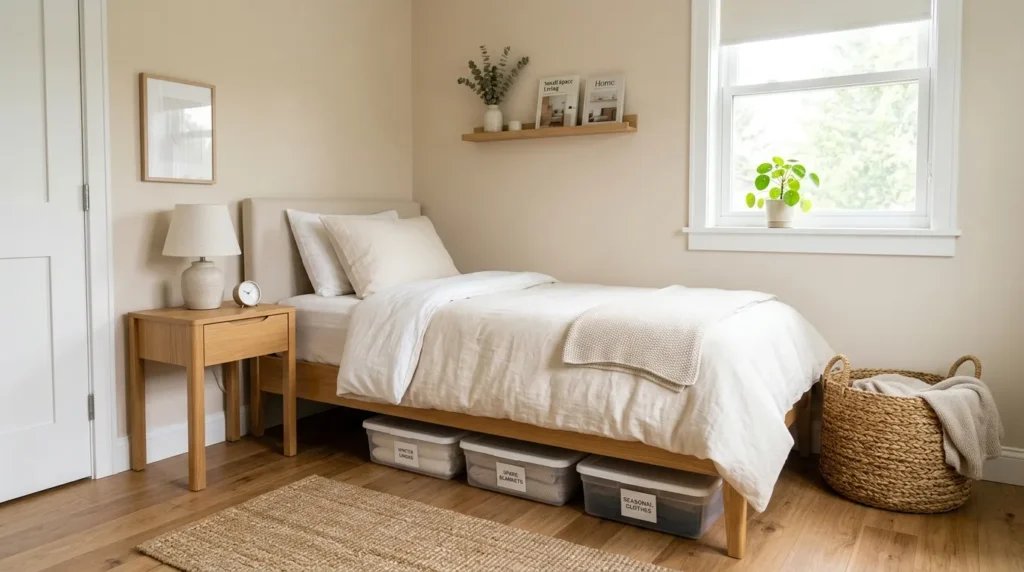
The space beneath a bed is one of the most overlooked storage areas in a small bedroom. Because the area is already occupied by the bed, using the space underneath doesn’t require sacrificing additional floor area.
It can be especially useful for items that aren’t needed every day, such as winter clothing, extra bedding, luggage, shoes, or keepsakes.
The key is choosing storage containers that are easy to access. If everything is packed into deep boxes that require moving half the bedroom to reach, the system won’t remain practical.
How To Style It
Measure the clearance beneath your bed before purchasing containers.
Use shallow lidded boxes, fabric storage bags, or rolling containers designed specifically for under-bed use.
Label each container so you know exactly what’s inside.
Group similar items together rather than mixing unrelated belongings.
For a cleaner appearance, choose matching containers in a neutral color if the storage is visible from certain angles.
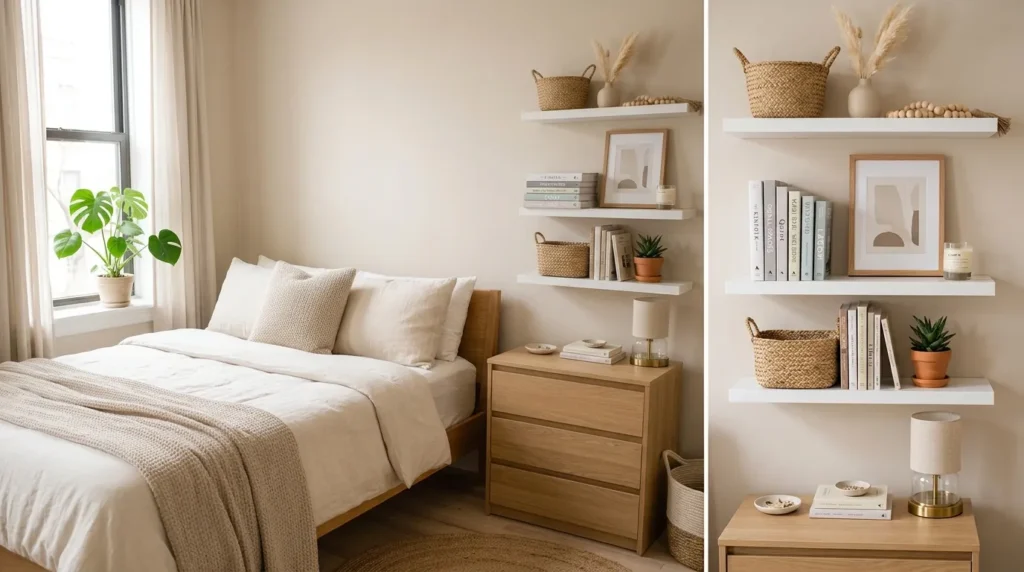
2. Vertical Wall Shelves
Quick Benefits
- Uses unused wall space
- Keeps floors clear
- Adds decorative storage
- Works in very small rooms
- Makes belongings easier to access
Why It Works
When floor space is limited, look upward.
Vertical storage takes advantage of wall height without making the bedroom footprint smaller. A few strategically placed shelves can hold books, baskets, accessories, plants, or decorative objects.
This approach is particularly useful beside a desk, above a dresser, or on a wall that isn’t suitable for another piece of furniture.
Open shelving also allows you to combine storage with decoration.
How To Style It
Install shelves high enough to keep the room feeling open while maintaining comfortable access to frequently used items.
Use baskets or small boxes for loose belongings.
Keep the shelves from becoming overcrowded.
Mix practical storage with a few decorative pieces.
If the bedroom is very small, choose shelves with a simple profile and a finish that blends with the wall.
Always use appropriate wall anchors and hardware for the wall type and expected load.
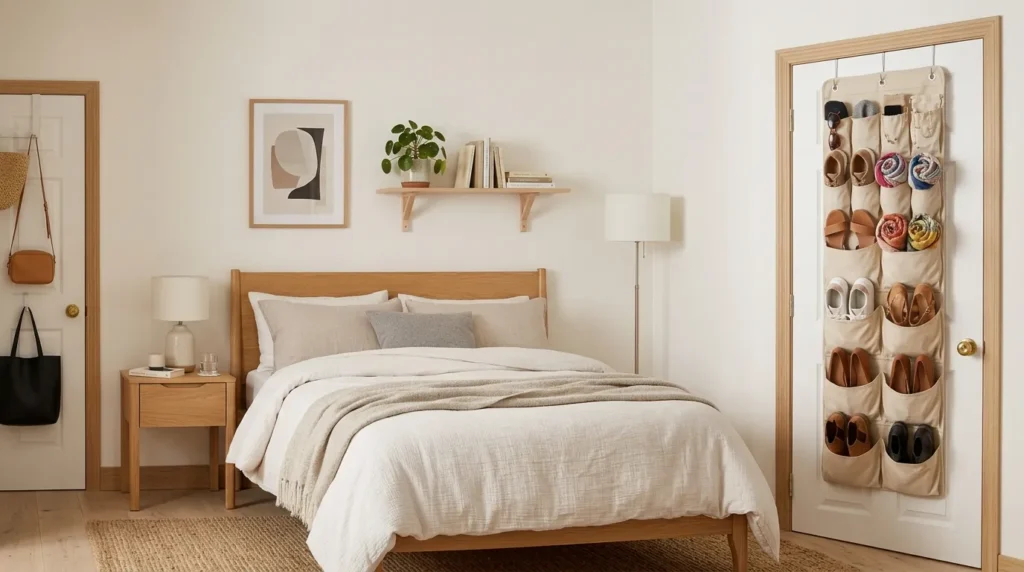
3. Over-Door Organizers
Quick Benefits
- Uses hidden vertical space
- Doesn’t require floor area
- Works for small accessories
- Easy to access
- Useful for renters
Why It Works
The back of a bedroom door provides valuable storage real estate that is often completely unused.
An over-door organizer can hold shoes, scarves, handbags, hair accessories, cleaning supplies, or other small items.
Because the storage stays behind the door when it’s closed, it doesn’t contribute much to the visual clutter of the room.
It’s one of the simplest solutions for adding storage without rearranging the entire bedroom.
How To Style It
Choose an organizer based on what you actually need to store.
Use clear pockets for small accessories or fabric compartments for softer items.
Keep frequently used belongings near eye level.
Avoid overloading the door, especially if the organizer is heavy.
For a more permanent setup, wall-mounted racks can provide a cleaner appearance, provided your rental or home allows appropriate installation.
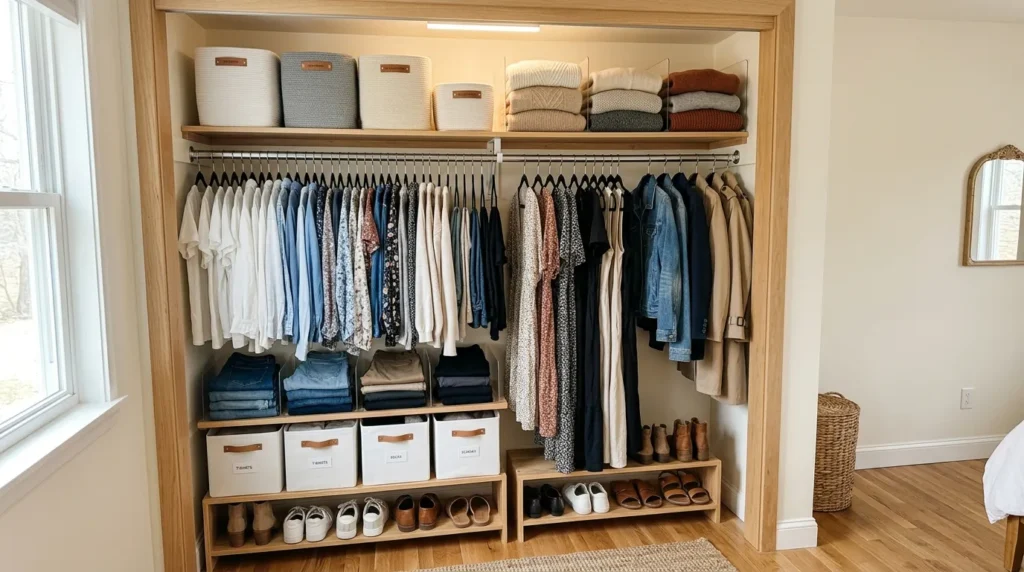
4. Closet Dividers
Quick Benefits
- Improves closet visibility
- Makes clothing easier to find
- Prevents overcrowding
- Creates logical categories
- Helps maintain organization
Why It Works
A small closet becomes difficult to manage when clothing is packed tightly together.
The goal isn’t simply to fit more clothes inside. It’s to make the available space easier to use.
Dividing clothing by type, season, or frequency of use creates a more logical system.
Matching hangers can also reduce visual clutter and make the closet feel more organized.
How To Style It
Start by removing clothing you no longer wear.
Group similar items together, such as shirts, dresses, jackets, and pants.
Use slim hangers where appropriate to maximize hanging space.
Add shelf dividers for folded clothing.
Use small bins for accessories that would otherwise get lost.
Keep everyday pieces at the easiest-to-reach level and less frequently used items higher up.
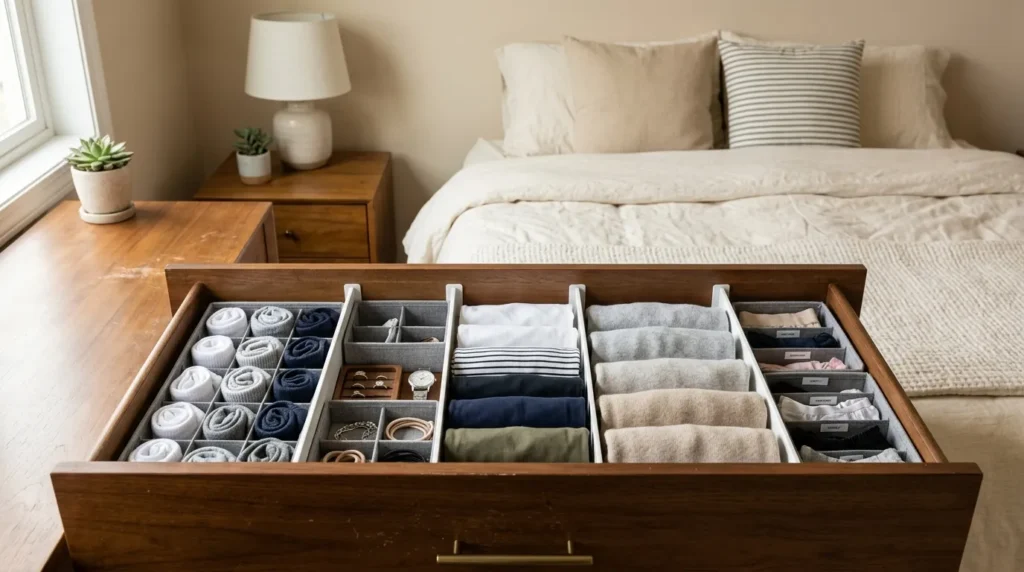
5. Drawer Organization
Quick Benefits
- Prevents messy drawers
- Makes small items easier to find
- Uses existing furniture
- Saves time
- Requires minimal investment
Why It Works
Drawers can become cluttered quickly because small items are easy to toss inside without a system.
Dividers create individual zones, preventing socks, underwear, accessories, and other belongings from becoming one large pile.
The best part is that you can organize drawers without adding another piece of furniture.
How To Style It
Empty one drawer at a time.
Group similar items together before deciding how much space each category needs.
Use adjustable dividers or small boxes.
Fold clothing vertically where practical so individual items remain visible.
Avoid filling every available space. A little extra room makes the drawer easier to use.
6. Wall-Mounted Hooks
Quick Benefits
- Uses vertical space
- Keeps bags off the floor
- Makes daily items accessible
- Works in narrow areas
- Easy to customize
Why It Works
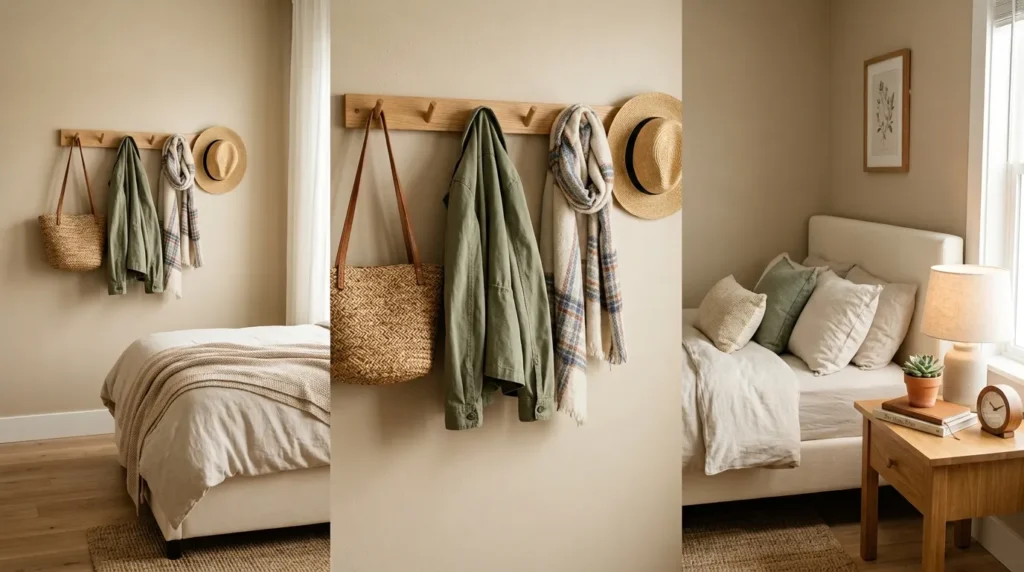
Hooks are simple, but they’re extremely effective in compact bedrooms.
A small row of hooks can hold handbags, hats, robes, scarves, headphones, or tomorrow’s outfit.
This is especially useful for items that are used frequently and don’t need to be placed inside a drawer or closet every time.
How To Style It
Install hooks near the bedroom entrance, beside the closet, or behind the door.
Use a simple wooden rail with hooks for a warmer look, or individual metal hooks for a more modern style.
Keep the number of visible items limited.
If everything you own is hanging on the wall, the storage itself can become visual clutter.
Use hooks primarily for frequently used belongings.
7. Multi-Use Furniture
Quick Benefits
- Saves floor space
- Adds hidden storage
- Makes furniture more useful
- Works in compact rooms
- Reduces the number of separate pieces
Why It Works
When a bedroom is small, every furniture piece should earn its place.
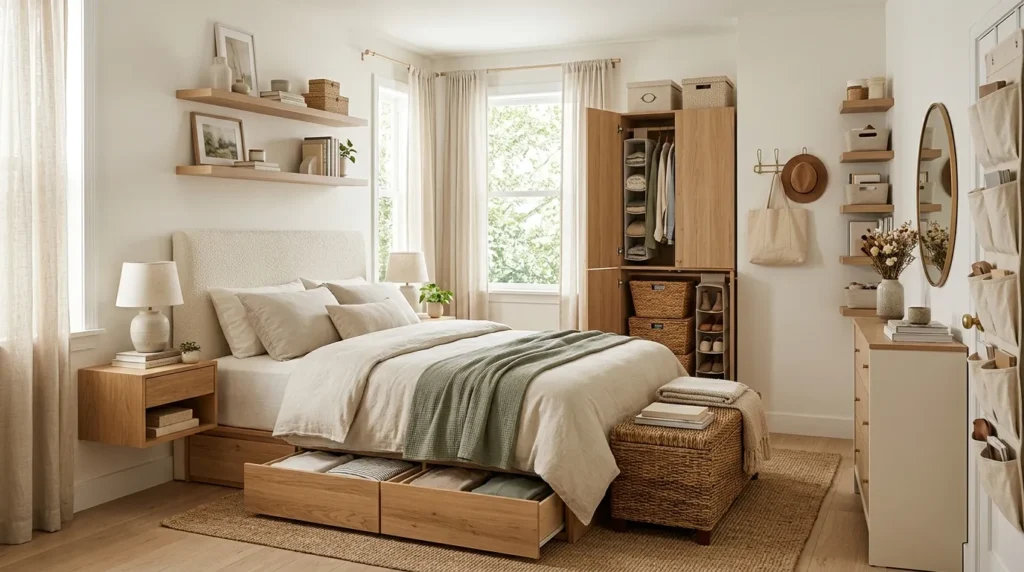
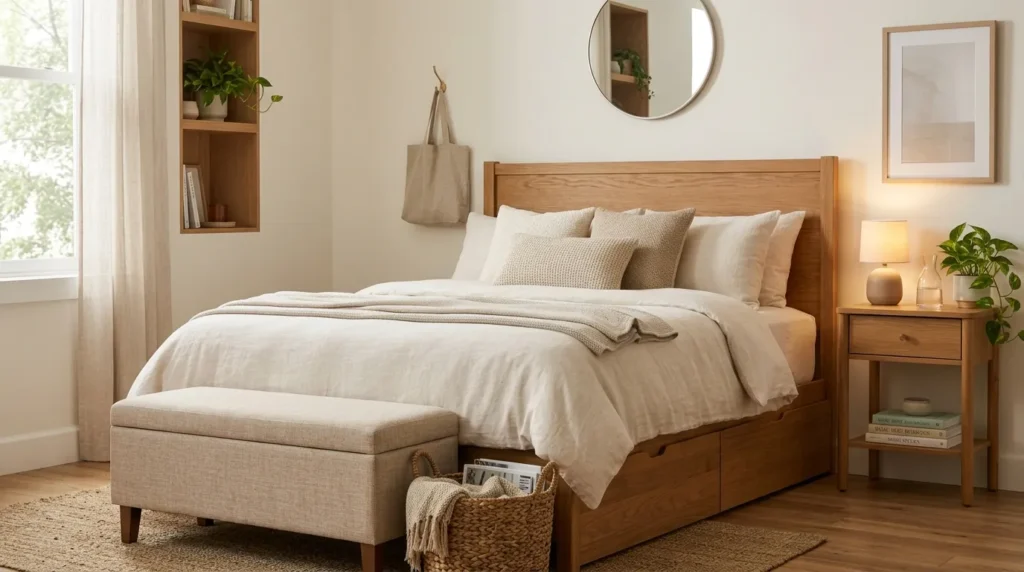
A storage bed can provide drawers underneath. A bedside table can include shelves or cabinets. A bench can provide both seating and hidden storage.
Furniture that performs two functions reduces the need for additional pieces.
This is especially helpful in rooms where a dresser, desk, nightstand, and bed already compete for limited floor space.
How To Style It
Look for furniture with built-in storage rather than adding separate organizers afterward.
Choose pieces that match the existing scale of the room.
A storage ottoman at the foot of the bed can hold blankets while providing a place to sit.
A narrow bedside cabinet can replace a larger nightstand.
Choose closed storage for items that would otherwise make the room look cluttered.
8. Corner Storage
Quick Benefits
- Uses awkward spaces
- Adds storage without major changes
- Works for shelves and baskets
- Makes rooms more functional
- Can create a decorative feature
Why It Works
Corners often become dead zones in small bedrooms.
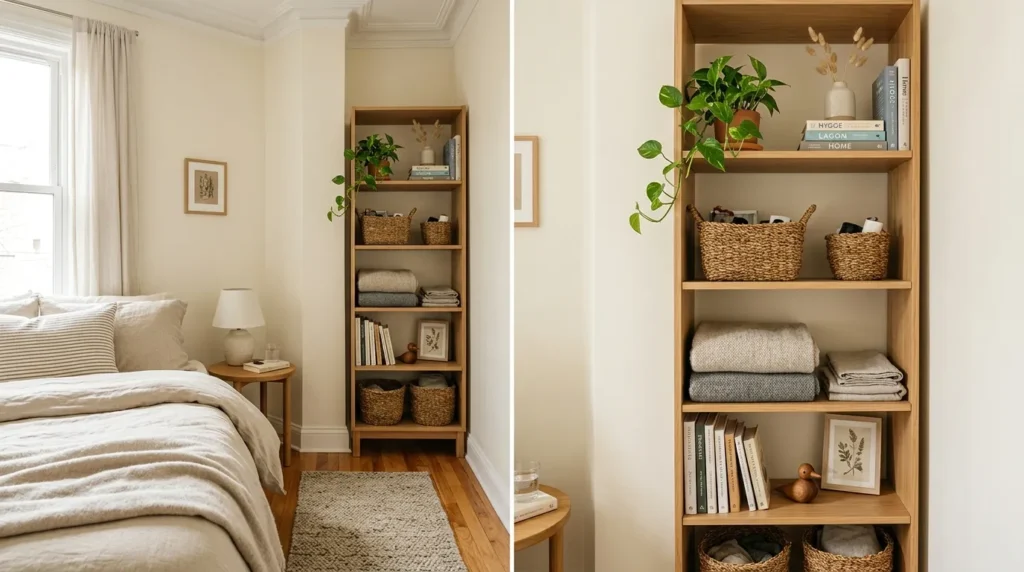
A narrow shelving unit, corner shelf, tall basket, or compact cabinet can turn an unused corner into useful storage.
The important thing is scale. Oversized furniture can make a small bedroom feel even tighter.
Vertical, narrow pieces generally work better than wide storage units.
How To Style It
Measure the corner carefully before purchasing anything.
Use tall shelving for books, baskets, and accessories.
Place a laundry hamper in an otherwise awkward corner.
A tall plant can occupy another empty corner while adding softness, although it shouldn’t interfere with movement.
Choose storage that visually blends with the room to avoid making the corner feel heavy.
9. Seasonal Rotation
Quick Benefits
- Frees closet space
- Keeps current clothing accessible
- Reduces visual clutter
- Makes seasonal transitions easier
- Helps identify unused items
Why It Works
A small bedroom becomes much easier to manage when you’re not trying to keep every seasonal item immediately accessible.
Heavy winter sweaters don’t need to occupy prime closet space during summer, and lightweight summer clothing doesn’t need to fill the easiest-to-reach drawers during winter.
Rotating belongings creates a more efficient system.
It also gives you a natural opportunity to evaluate what you actually used during the previous season.
How To Style It
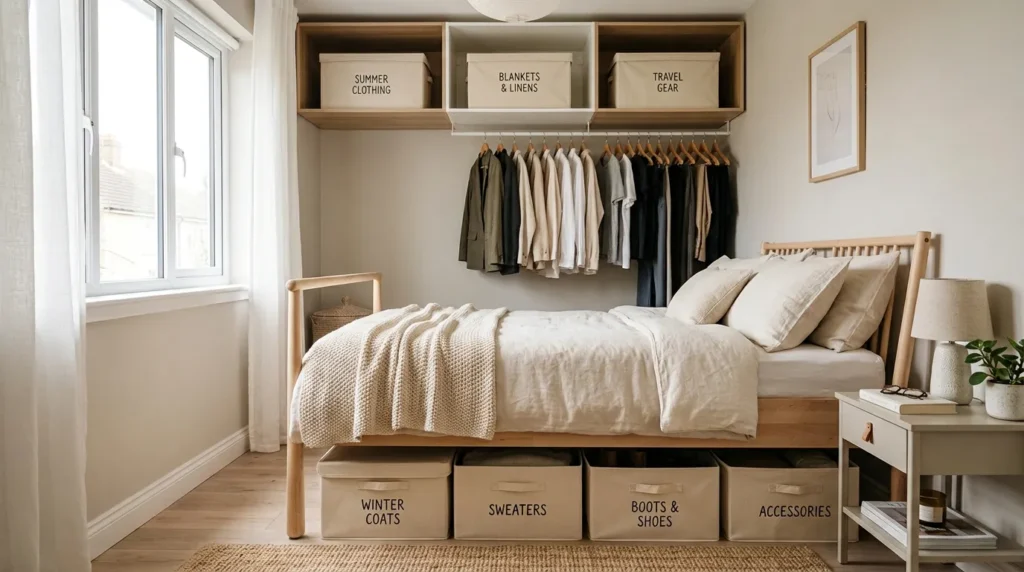
Store off-season clothing in labeled containers under the bed, on high closet shelves, or in another appropriate storage area.
Clean and completely dry clothing before storing it.
Fold heavier items rather than hanging everything.
Use breathable storage solutions for clothing where appropriate.
When changing seasons, take the opportunity to donate or remove pieces that no longer fit your lifestyle.
10. Decluttered Surfaces
Quick Benefits
- Makes rooms feel larger
- Reduces visual stress
- Simplifies cleaning
- Highlights decorative pieces
- Makes organization easier
Why It Works
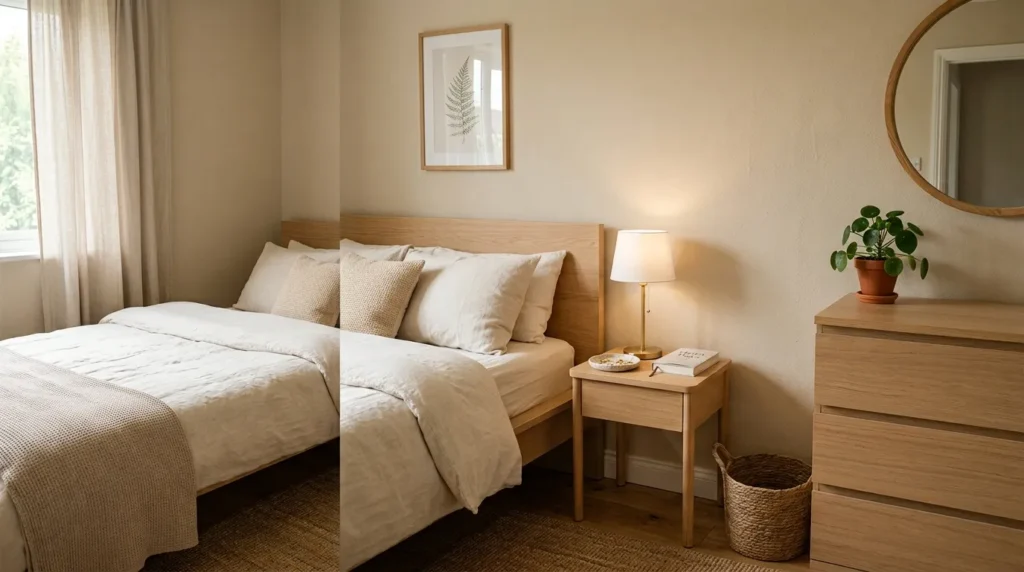
Even when storage is technically available, a bedroom can still feel messy if every visible surface is covered.
Nightstands, dressers, desks, and shelves quickly become collection points for everyday belongings.
Keeping these surfaces relatively clear creates an immediate sense of spaciousness.
This doesn’t mean removing everything. It means deciding what deserves to remain visible.
How To Style It
Keep only frequently used or genuinely decorative pieces on visible surfaces.
Use a small tray to organize perfume, jewelry, or personal essentials.
Keep charging cables contained rather than scattered across the nightstand.
Limit decorative objects to a few meaningful pieces.
Create a simple evening reset routine: return clothing to its proper location, clear surfaces, and prepare the room for the next day.
How to Organize a Small Bedroom Step by Step
If your bedroom currently feels overwhelming, don’t try to organize everything at once.
Step 1: Remove obvious clutter
Start with trash, empty packaging, unwanted clothing, and items that belong somewhere else.
Step 2: Sort by category
Group clothing, shoes, books, accessories, paperwork, and personal belongings.
Step 3: Identify unused spaces
Look beneath the bed, behind doors, above furniture, inside corners, and along vertical walls.
Step 4: Prioritize everyday items
Keep frequently used belongings easy to reach.
Step 5: Store seasonal items separately
Move less frequently used belongings away from prime storage areas.
Step 6: Add organizers only after sorting
Buying storage containers before decluttering often creates more things to manage.
Step 7: Label where useful
Labels are particularly helpful for under-bed containers and high shelves.
Step 8: Maintain the system
Spend a few minutes each day returning items to their designated locations.
How to Make a Small Bedroom Feel Bigger
Organization and visual design work together.
Use lighter colors on walls and larger furniture when possible. Keep pathways clear and avoid oversized furniture that makes movement difficult.
Mirrors can reflect light and create a greater sense of depth, while curtains hung closer to the ceiling can emphasize vertical space.
Another simple trick is to keep the floor as visible as possible. Furniture with raised legs can create a more open appearance than bulky pieces that sit directly on the floor.
Good lighting matters too. Use bedside lamps, wall lights, or other layered sources rather than relying entirely on one overhead fixture.
The goal is to create both physical and visual breathing room.
Storage Mistakes to Avoid
Even good storage ideas can become counterproductive when used incorrectly.
Buying containers before decluttering
You may end up organizing belongings you don’t actually need.
Filling every shelf
Storage doesn’t have to be completely full to be useful.
Ignoring accessibility
Items used every day should not be stored in difficult-to-reach places.
Choosing oversized furniture
A large dresser may provide more drawers but leave little room to move.
Mixing unrelated categories
Keeping everything in one large storage box makes finding items harder.
Forgetting maintenance
An organizational system only works when it’s easy enough to maintain.
FAQ
How can I organize a very small bedroom?
Start by decluttering, then use unused vertical and hidden spaces. Under-bed containers, wall shelves, hooks, over-door organizers, and multifunctional furniture can add storage without taking much floor space. Keep frequently used belongings accessible and move seasonal items into less valuable storage areas.
What should I store under my bed?
Under-bed storage works well for seasonal clothing, extra bedding, shoes, luggage, accessories, and items you don’t use every day. Use shallow containers that are easy to pull out and label them so you don’t have to open multiple boxes to find something.
How do I organize a small bedroom without buying furniture?
Use what you already have more efficiently. Declutter clothing, add inexpensive drawer dividers, use hooks, organize existing shelves, utilize the back of doors, and place containers beneath the bed. Rearranging furniture can also free up overlooked areas.
How do I make my small bedroom look less cluttered?
Keep visible surfaces relatively clear, use closed storage for loose belongings, limit decorative accessories, and maintain open floor space. A consistent color palette can also reduce visual noise and make the room feel calmer.
Is vertical storage good for a small bedroom?
Yes. Vertical storage makes use of wall space while preserving floor area. Shelves, hooks, tall cabinets, and over-door organizers can all provide additional storage without significantly reducing walking space.
How do I organize a small bedroom closet?
Start by removing items you no longer use. Group clothing by category, use slim hangers where appropriate, add shelf dividers or bins, and keep frequently worn pieces within easy reach. Seasonal rotation can also free valuable closet space.
How often should I declutter a small bedroom?
A quick weekly reset can prevent clutter from building up. A more thorough review every few months is useful for clothing, accessories, and seasonal belongings. Small, regular sessions are generally easier to maintain than occasional major cleanouts.
Conclusion
Organizing a small bedroom doesn’t require a complete renovation or a room full of expensive storage furniture. The most effective solutions often come from using space that was already there.
Start beneath the bed, behind the door, along the walls, and inside corners. Then improve the storage you already have with drawer dividers, closet organizers, baskets, and simple labels.
Most importantly, don’t organize clutter simply to make it look tidy. Remove things you no longer use, group similar belongings together, and give the items you keep a logical home.
A well-organized small bedroom should make everyday life easier. You should be able to find your clothes, put things away quickly, and move around the room without constantly working around piles of belongings.
Choose one area to tackle first. Once that space is working well, move to the next. With a few practical changes and a simple maintenance routine, even a very compact bedroom can feel comfortable, orderly, and surprisingly spacious.
Related Articles
- How to Make a Small Bedroom Feel Bigger Without Renovating
- 10 Small Bedroom Ideas with Smart Storage
- How to Decorate a Small Bedroom on a Budget
- 10 Bedroom Organization Ideas for Everyday Living
- 10 Minimal Bedroom Decor Ideas for a Calm Space